








If you work with steel pipes, you’ve probably wondered whether a single steel pipe testing machine — especially a hydrostatic tester — can handle both seamless and welded pipes. After all, seamless and welded pipes are made differently and often used in different applications. The good news is: yes — most modern testing machines are designed to test both types, and in practice this is very common on pipe production lines and in quality control labs. Below is a clear, non-AI-sounding explanation that explains how and why this works, what to watch out for, and how it looks on the shop floor.
What are seamless and welded pipes? A quick primer
Before we dive into testing, let’s quickly review the two common pipe types:
-
Seamless pipes are made from a solid billet that’s heated and pierced into a hollow tube. There’s no weld seam along the length, so the pipe body is uniform.
-
Welded pipes are formed by bending a strip or plate of steel and welding the edges together (like ERW, SSAW or LSAW). That weld line becomes part of the finished product.
Both types are widely used in industry — seamless pipes often for higher-pressure service, and welded pipes for longer runs or larger diameters where cost matters.
What does a steel pipe testing machine actually check?
A typical testing machine checks a pipe’s ability to withstand internal pressure without leaking or deforming. That’s usually done by:
-
Filling the pipe with water or another fluid
-
Increasing internal pressure to a set level (often above expected working pressure)
-
Holding that pressure for a specified time
-
Observing whether any leaks or permanent deformation occur
This method — commonly called hydrostatic testing — doesn’t care how the pipe was made. Whether the pipe has a seam or not, pressure holds the same meaning physically.
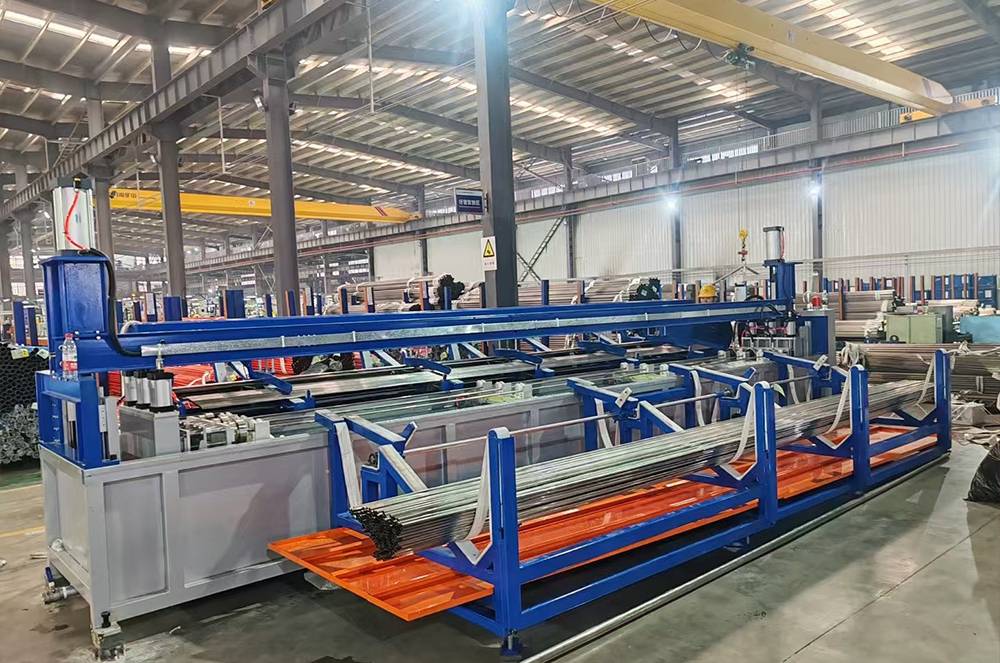
Can the same machine do both? Yes — here’s how
Most modern steel pipe testing machines — especially hydrostatic testers — are engineered to accommodate a range of pipe types, including:
-
Seamless pipes
-
ERW (electric resistance welded) pipes
-
Spirally welded pipes (SSAW)
-
Longitudinal welded pipes (LSAW)
Their design doesn’t depend on whether a pipe has a seam. They pressurize the pipe and monitor for leaks or deformation just the same.
In fact, product specifications from several manufacturers explicitly state that their hydrostatic testers are suitable for ERW, seamless, SSAW, and LSAW pipes.
Why this works
Hydrostatic pressure is a scalar physical force — it acts equally on the inner surface of any pipe, no matter how it’s made. The testing machine simply applies the pressure and watches the response. The presence of a weld doesn’t change how the pressure is applied; it simply affects where failures are more likely to occur.
For example, when a welded pipe is pressurized, the weakest point — often the weld — is more likely to reveal deformities or leakage. Seamless pipes, without that seam, may show different performance characteristics under the same testing regimen.
How this looks on the production floor
In practical inspection and testing workflows:
-
Pipe is loaded into test machine — regardless of type.
-
Seals or end caps are installed — these are configured to match the pipe diameter, not its manufacturing process.
-
Test sequence runs — fill, pressurize, hold, depressurize.
-
Machine logs results — digital recording or printed certificate.
The data logged — peak pressure, hold time, leak detection — is interpreted in light of the pipe type. Welded pipes often also get additional checks (such as ultrasonic or radiographic inspection on the weld seam), but the pressure test itself is the same core operation for both.
Do standards support this mixed usage?
Yes. International pipe and tube standards often apply hydrostatic testing to both seamless and welded pipes, specifying required pressures based on wall thickness and diameter, not on production method. While some industry specifications may add extra requirements for weld quality, the basic pressure test is consistent across types.
Quick comparison table
|
Feature |
Seamless Pipe |
Welded Pipe |
| Manufacturing | Solid billet, no weld seam | Formed and welded from plate/strip |
| Hydrostatic testing method | Same as welded | Same as seamless |
| Typical failure focus | Material defects | Weld seam defects |
| Additional NDT often used | Ultrasonic, eddy current | Ultrasonic on weld, RT for welds |
| Machinery requirement | No special machine differences | No special machine differences |
Tips for accurate testing across both pipe types
-
Calibrate devices frequently — pressure transducers and gauges must be accurate for both pipe types.
-
Ensure proper sealing — a good end seal ensures pressure stays internal regardless of pipe type.
-
Use NDT on welds separately — welded pipes benefit from ultrasonic or radiographic checks on the weld seam before or after pressure testing.
-
Read standards carefully — many standards include additional weld integrity checks along with hydrostatic testing.
A steel pipe testing machine can test both seamless and welded pipes. The equipment applies the same basic hydrostatic principle to both, and many machines on the market are specifically designed to handle multiple pipe types (ERW, seamless, SSAW, LSAW). While test parameters and additional inspections may vary depending on the pipe type and standard, the core testing method remains the same — giving manufacturers and quality teams a unified tool for pressure integrity testing.