








The required hydrostatic test pressure for steel pipe is determined by the applicable pipe or piping standard, design or service requirements, pipe dimensions, material grade, test temperature, and purchaser specifications. It is not a universal value based only on pipe diameter or working pressure.
For manufacturers planning a hydro testing machine for pipe, this distinction is important. The machine should be configured from the actual pipe and test requirements, rather than selecting a pressure rating first and trying to fit the pipe afterward.
What Determines Hydrostatic Test Pressure?
| Factor | Engineering Effect | What the Equipment Supplier Needs |
|---|---|---|
| Applicable standard | Defines the test method and pressure basis | Standard and edition |
| Design/service pressure | May establish the pressure basis for system testing | Design pressure or required test pressure |
| Outside diameter | Affects circumferential stress and sealing load | Minimum and maximum OD |
| Wall thickness | Influences pressure stress and allowable test condition | Nominal/minimum wall thickness |
| Material grade | Determines applicable strength and allowable stress | Steel grade |
| Test temperature | Can affect allowable stress | Test and design temperature where applicable |
| Customer specification | May add pressure or holding-time requirements | PO/project specification |
| Production requirements | Determines filling, pressurizing and cycle-time requirements | Required output and automation level |
1. The Governing Standard Comes First
The first step is not calculating pressure. It is identifying which specification governs the test.
This is important because different standards use different approaches.
For example, ASME B31.3 covers process piping rather than treating every manufactured steel pipe as an isolated product. Under its hydrostatic leak-test provisions, the test pressure is generally not less than 1.5 times the design pressure, with a temperature-related adjustment when the design temperature is higher than the test temperature.
A steel pipe product specification can use a different basis. ASTM A53/A53M, for example, specifies hydrostatic testing of covered welded and seamless steel pipe as part of the product requirements, with the test intended to verify pipe integrity rather than establish a universal relationship to a customer's operating pressure.
Therefore, “1.5 × working pressure” should not be treated as a universal formula for steel pipe.
The applicable product standard, project specification and purchase order must be checked first.
2. Design Pressure Is Important — But It Is Not Always the Test Pressure
For pressure piping designed under ASME B31.3, the hydrostatic test pressure is based on design pressure and may be adjusted according to allowable stress at the test and design temperatures.
A simplified form of the ASME relationship is:
PT = 1.5 × P × ST / S
where:
- PT = minimum hydrostatic test pressure
- P = internal design gauge pressure
- ST = allowable stress at test temperature
- S = allowable stress at design temperature
This calculation belongs to the applicable ASME piping-code context. It should not automatically be transferred to every steel pipe product.
For a pipe manufacturer, the practical question is therefore:
What pressure does the governing specification require for this particular pipe?
That answer should come from the applicable standard and customer requirements before the testing machine is configured.
3. Pipe Diameter and Wall Thickness Affect the Pressure Condition
Pipe geometry directly affects the stress produced by internal pressure.
For a thin-wall cylindrical approximation:
Hoop stress ≈ P × D / 2t
where:
- P = internal pressure
- D = pipe diameter
- t = wall thickness
At the same test pressure, a larger diameter produces higher circumferential stress when wall thickness remains unchanged. A thicker wall reduces the corresponding stress.
| Change in Pipe Specification | Engineering Consequence |
|---|---|
| Larger OD, same wall | Higher pressure-induced hoop stress |
| Smaller OD, same wall | Lower hoop stress |
| Same OD, thinner wall | Higher stress at the same pressure |
| Same OD, thicker wall | Lower stress at the same pressure |
| Different steel grade | May change allowable stress or applicable specification |
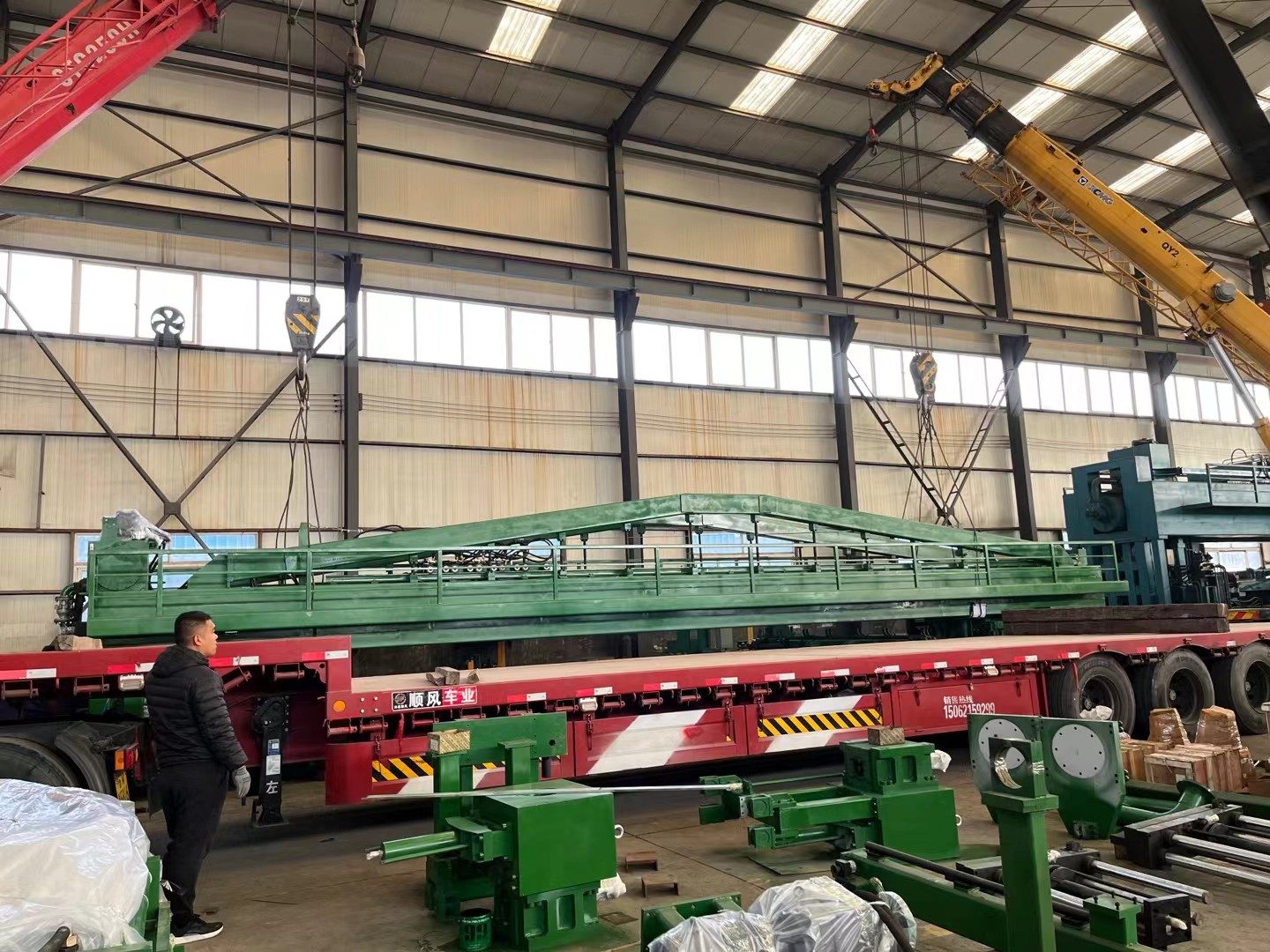
This is one reason a steel pipe hydrostatic testing machine covering several pipe sizes cannot be specified only by its maximum pump pressure.
The machine also needs a sealing system and mechanical arrangement that can safely accommodate the full pipe diameter and wall-thickness range.
4. Material Grade Sets Another Limit
Material strength must also be considered.
A hydrostatic test is not intended to push the pipe toward uncontrolled yielding. The specified pressure must remain within the limits established by the governing specification and the pipe's material condition.
This becomes particularly important when a manufacturer tests several grades on the same pipe hydrostatic testing machine.
For example, changing from one carbon-steel grade to a higher-strength alloy or stainless grade does not automatically mean that the machine pressure should simply be increased. The applicable standard determines how the material properties enter the test requirement.
The machine supplier therefore needs the actual material grade, not simply “steel pipe.”
5. Test Temperature Can Change the Required Pressure
Temperature is often overlooked when test pressure is discussed.
Under ASME B31.3, when the design temperature is higher than the test temperature, the minimum hydrostatic test pressure is calculated using the ratio of allowable stress at the test temperature to allowable stress at the design temperature.
For a production pipe-testing line, the situation may be simpler because the test procedure can be specified directly by the product standard. Nevertheless, temperature should still be considered whenever the applicable specification makes it relevant.
The important point is that test pressure should come from the governing engineering requirement, not from a fixed machine setting.
6. Customer Requirements Often Complete the Specification
In actual equipment projects, the standard is not always the only input.
A customer may specify:
- test pressure;
- holding time;
- pipe length;
- pipe OD range;
- wall thickness;
- test medium;
- pressure tolerance;
- leakage acceptance criteria;
- automatic recording;
- production capacity;
- data storage or traceability.
This is where equipment configuration becomes project-specific.
At Marley Machinery, we normally configure a steel pipe hydrostatic testing machine from the customer's pipe range and testing requirements. We do not assume that one standard machine configuration is suitable for every steel pipe mill.
For example, a customer producing several pipe diameters may need one machine to handle a wide sealing range. Another customer with a narrow pipe range but high production volume may place more emphasis on multi-station testing and cycle time.
The required pressure is only one part of that configuration.
7. What Does the Required Pressure Mean for the Hydro Testing Machine?
Once the required test pressure has been established, it should be translated into actual machine requirements.
| Test Requirement | Machine Configuration to Check |
|---|---|
| Maximum test pressure | Pump, valves, piping, seals and pressure-rated components |
| Multiple pipe diameters | Sealing range and end-head design |
| Long steel pipes | Filling, venting and water drainage capacity |
| Short cycle time | Pump flow, filling system and station arrangement |
| Long holding time | Pressure-control stability and instrumentation |
| Automatic testing | PLC sequence and pressure monitoring |
| Quality records | Pressure curve, test result and data storage |
| High production volume | Number of test stations and material handling |
This is an important distinction between buying a pump and specifying a hydro testing machine for pipe.
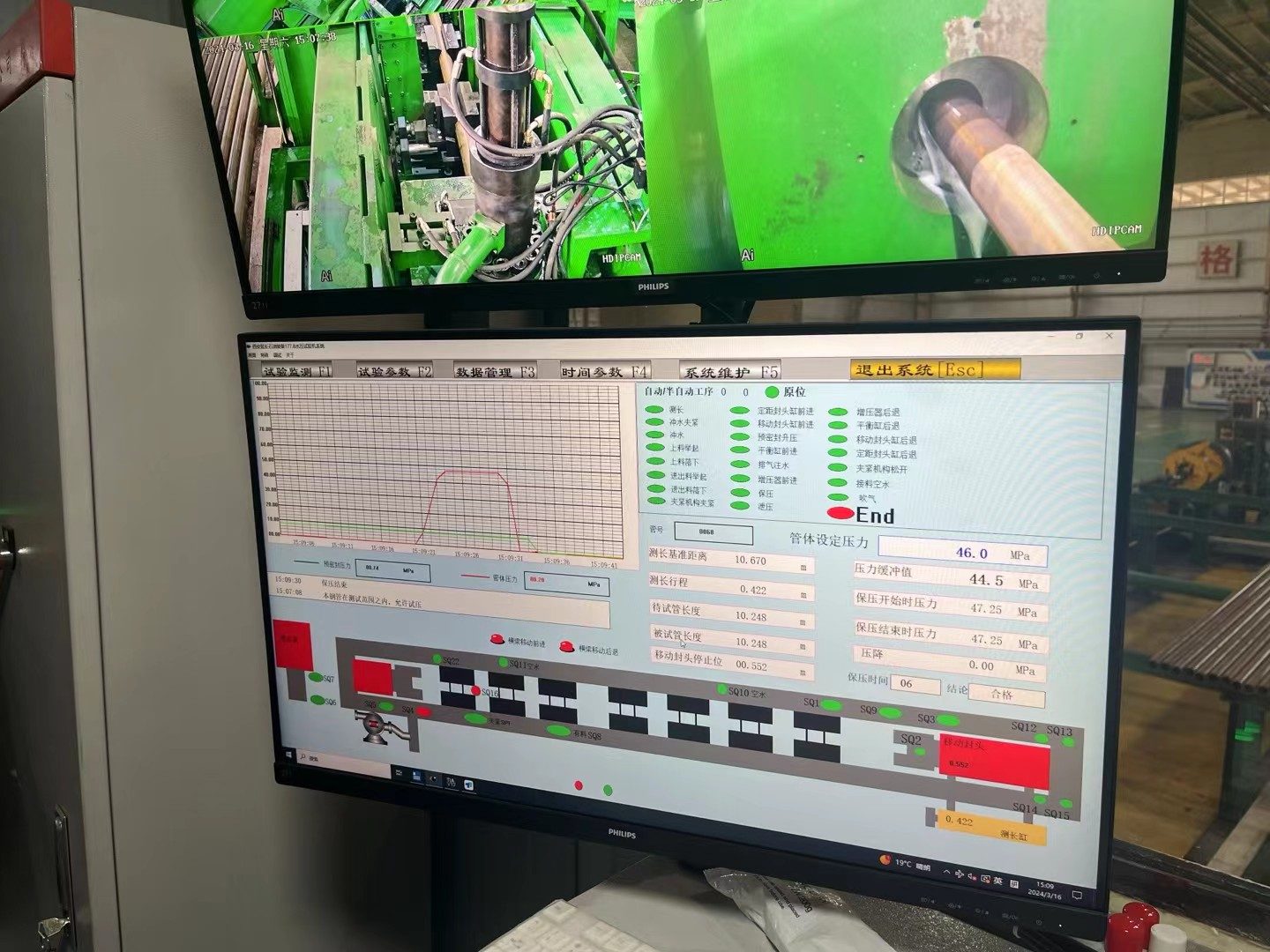
A pump may be capable of reaching the required pressure, but the complete testing machine must also fill the pipe, remove trapped air, establish the specified pressure, maintain it for the required time, detect abnormal pressure loss, release pressure safely and handle the pipe through the production cycle.
A Practical Way to Determine the Test Pressure
For a new steel pipe hydrostatic testing project, we recommend working through the following sequence:
1. Identify the governing standard.
Determine whether the requirement comes from a product standard, piping code, project specification or customer purchase order.
2. Confirm the pipe range.
Provide OD, wall thickness, length and material grade.
3. Confirm the required test condition.
Specify test pressure, holding time, test medium and temperature where applicable.
4. Check the complete pressure boundary.
The pipe is not the only pressure-bearing part of the test system. Sealing heads, valves, hoses, manifolds and other pressure-containing components must also be suitable for the intended test condition.
5. Configure the machine around the production requirement.
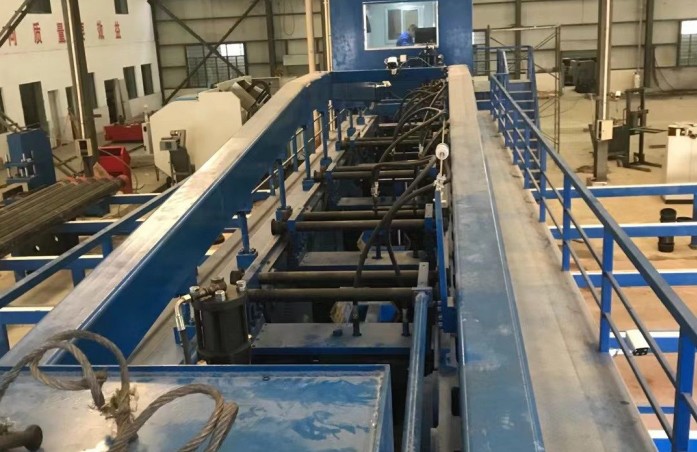
Pressure capacity, filling speed, sealing arrangement, automation and number of stations should be selected together.
Final Engineering Check
Before ordering a hydrostatic testing machine for steel pipe, the following information should be available:
| Item | Example Input |
|---|---|
| Pipe type | Seamless / welded |
| OD range | Customer-specific |
| Wall thickness | Customer-specific |
| Length range | Customer-specific |
| Material | Carbon steel / stainless / alloy |
| Test pressure | Standard or customer requirement |
| Holding time | Standard or customer requirement |
| Production capacity | Pipes/hour or cycle requirement |
| Automation | Manual / semi-automatic / automatic |
This information allows the equipment supplier to determine the appropriate pump pressure, flow capacity, sealing method, pressure-control system and handling configuration.
The required hydrostatic test pressure for steel pipe is determined by a combination of the governing standard, design or service requirements, pipe geometry, material grade, temperature and customer specifications. There is no single pressure value that applies to every steel pipe.
For ASME B31.3 process piping, the hydrostatic test requirement is linked to design pressure and allowable stress. Product specifications such as ASTM A53 use their own product-testing requirements.
For equipment selection, the practical approach is to start with the customer's actual pipe and test specification and then configure the hydro testing machine for pipe around it.
At Marley Machinery, this is how we approach custom steel pipe hydrostatic testing equipment: the machine configuration follows the pipe, test standard and production requirement—not the other way around.